
In this article, we will develop all the fundamentals of Arbitrage Pricing Theory (APT) and price discovery processes.
What is Price Discovery?
The Price Discovery process, also known as price discovery, refers to the determination of a common price for any asset. This phenomenon occurs when a seller and a buyer interact on a centralized exchange. In futures markets, this task is facilitated by their ability to broadcast information instantly worldwide.
import numpy as np
from sklearn.linear_model import LinearRegression

# Arbitrage Pricing Theory: estimate factor loadings
# R_i = a_i + b_i1*F1 + b_i2*F2 + ... + epsilon_i

# Factor returns: market, size, value
factors = np.array([[0.02, 0.01, -0.005],
                    [0.03, -0.02, 0.01],
                    [-0.01, 0.03, 0.02]])

# Asset returns
asset_returns = np.array([0.025, 0.015, 0.01])

# Regress asset returns on factors to get loadings (betas)
reg = LinearRegression().fit(factors, asset_returns)
print(f"Alpha (intercept): {reg.intercept_:.4f}")
print(f"Factor loadings: {reg.coef_}")

# No-arbitrage condition: alpha should be ~0
# If alpha != 0, there's an arbitrage opportunity
The Price Discovery process refers to the determination of a common price for any asset. This phenomenon occurs when a seller and a buyer interact on a centralized exchange. In futures markets, this task is facilitated due to their ability to broadcast information instantaneously worldwide, allowing greater efficiency in price determination.
Price discovery is the result of the collaboration of millions of people with millions of neurons working toward the same objective: properly valuing a price in order to obtain profitability. These people risk capital based on the certainty they have in their theories or strategies. Buyers and sellers, day after day, exchange paper for money and vice versa, thus generating the phenomenon of price discovery at the exact moment the order is crossed.
For a price to be considered fair, it is fundamental that it occurs in an environment where traders feel safe and perceive the market as efficient for carrying out their transactions. For example, a wheat trader in Soria and another in Australia could trade the same asset at the same time, assuming the same type of risk and at the same price. This is achieved thanks to the connectivity and real-time information transmission capacity offered by modern markets, allowing traders from different parts of the world to interact and establish prices in an equitable and efficient manner.
Supply and demand in the market are constantly changing due to the stochastic nature of the process and the influence of news and events that act as the main reasons for market participants to modify their objectives. They continuously adjust their prices to reflect the factors that have changed and their new expectations regarding price.
Risk Transformation
Price Discovery procedures are fundamental for market makers to offer liquidity and precisely determine the current price. When uncertainty is theoretically limited, spreads tend to narrow, but when this does not occur, spreads tend to widen, resulting in a temporary lack of liquidity. Additionally, the price discovery process, when used properly, can identify arbitrage opportunities, where theory suggests alpha can be obtained without risk. However, in reality, risks cannot be eliminated, only transformed.
Conclusions on Price Discovery Processes
All the information available to you as a trader may also be available to other traders. Additionally, it is important to note that you are generally one of the least influential participants in the supply chain, as most are in the same position. The price discovery process follows a complex and incomprehensible order, the result of an unpredictable stochastic process, where agents constantly adjust their portfolios and adapt their biases to achieve expected returns.
In a centralized market, the price is the same for all participants. You are likely to find yourself in a disadvantageous position in the order book.
Arbitrage is a financial strategy based on taking advantage of imbalances between two or more markets to obtain a "risk-free profit." This approach focuses on extracting alpha from market microstructure, rather than relying on predictions or other factors.
Arbitrage Pricing Theory (APT)
Arbitrage theory, or Arbitrage Pricing Theory, consists of the simultaneous purchase and sale of two assets with similar characteristics in different markets while there is a difference in their respective prices.
What is Arbitrage Pricing Theory?
Formula
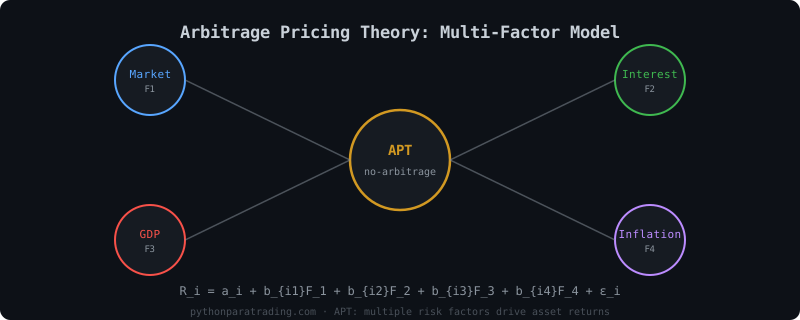
APT or Arbitrage Pricing Theory is a model formulated by Stephen A. Ross in 1976 where he concludes that:
- The expected return of a financial asset can be modeled as a linear function of different factors. Where the variation of expected results is given by:
$$E(R)_i = E(R)_z + (E(I) – E(R)_z) * \beta_n$$
Where:
$$E(R)_i$$ = Expected return
$$R_z$$ = Risk Free RoR
$$\beta_n$$ = sensitivity of price to factor n
$$E_i$$ = Risk premium of the factor
Each factor being cataloged as the result of a stochastic process, with a random nature.
The author notes that for the formula to hold, the following must be true:
- Perfect competition exists (unmanipulated markets, etc.)
- And that F < (total number of assets).
APM
APM or Arbitrage Pricing Model is a model that applies APT through expectation arbitrage. Consequently, once the imbalance is known, it is exploited by market participants, correcting the inefficiency.
Under the APT framework, the operator will model the equilibrium of expectations through trading two assets. One of which is valued at the correct price, and the other is not. Selling the more expensive one and using the purchasing power obtained to buy the one with the correct price, or vice versa.
The premise that one of the two assets is mispriced is a fundamental condition to proceed with any arbitrage.
$$R_i = a_i + \sum_{k=1}^{K} b_{ik} F_k + \epsilon_i$$
$$\mathbb{E}[R_i] = r_f + \sum_{k=1}^{K} b_{ik} \lambda_k$$
$$\beta_i = \frac{\text{Cov}(R_i, R_m)}{\text{Var}(R_m)}$$
Principle of NO Arbitrage
This principle is derived from the market, since in a market where risk-free profits cannot be obtained, and where risk is always related to returns, it would not make sense to be able to perform arbitrage effectively without assuming risks. This, to some extent, contradicts part of APT.
Extreme Example
In an extreme case, we could benefit without initial capital and without risk. Imagine a situation where a great disorganization occurs in a market and a system error in the broker occurs, allowing us to take extremely advantageous positions.
Paco from Cuenca wants to buy an SPX future at 6001
Jorge from Cadiz wants to sell an SPX future at 45000
It seems Paco and Jorge are showing inefficiency by giving away money. Taking advantage of the broker system error, you could sell Paco an SPX future at a price of 6001 and then buy it back from Jorge. This way, you would be satisfying the needs of all participants and obtaining risk-free profitability from the market for free.
This process of discovering the inefficiency would generate constant orders in that "arbitrage opportunity" until the profitability of the operation disappears.
Principle of No Arbitrage
If capital at time 0 is 0, it is impossible for it to be greater than 0 at time 1. This simple principle is a fundamental part of the no-arbitrage principle.
If:
$$c(0) = 0$$
It is impossible that:
$$c(1) > 0$$
It is impossible for any investor to obtain profitability without assuming risk and without having initial capital. If a portfolio existed that violated this basic principle, an arbitrage opportunity would open. Even if a profitability opportunity with capital but without risk were found, as in the case of triangular arbitrage, this opportunity would be exploitable and viable for utilization.
It is important to note that risk is not actually eliminated through mathematical methods, but rather transformed. In these cases, directional risk can become counterparty risk, liquidity risk, or other types of risks.
The risks of investing in stochastic models are impossible to eliminate, they can only be modulated or transformed.
In the real world, arbitrage opportunities are rare and, if they exist, profits tend to be very limited compared to the volume and transaction costs involved. This makes them unattainable for small investors and unattractive for large ones.
Additionally, situations where the no-arbitrage principle is violated are usually ephemeral and occur due to an increase in the noise that participants bring to the market at specific moments.
Quantitative investors professionally dedicated to these techniques, but at more advanced levels of abstraction, ensure that this principle remains intact. Models that argue violations of the no-arbitrage principle are some of the most used in the history of quantitative models, evolving into various models today. The digitization of markets has eliminated any possibility of arbitrage in liquid markets due to the ease of exploitation, where ultimately, the fastest is who can take advantage of those micro-imbalances.
Resources on Arbitrage Pricing Theory